
History of the Kyuden Group
History History of the Kyuden Group
Since its founding in 1951, Kyushu Electric Power has supported customers' daily lives and contributed to the development of local communities by providing a stable supply of electricity. We invite you to explore the History of the Kyuden Group, which has expanded its business domains in response to changing times and continues to take on the challenge of creating new value.
1951
1951 Founding of Kyushu Electric Power
1951 was a year in which Japan moved forward from the chaos of the postwar years towards recovery with the signing of the San Francisco Peace Treaty.Japan Electric Generation and Transmission Company and the nine regional power distribution companies, which operated under state control during the war, were reorganized into private companies responsible for the entire process of power generation, transmission, and distribution, with the country divided into nine supply areas. As one of these companies, Kyushu Electric Power was established on May 1.
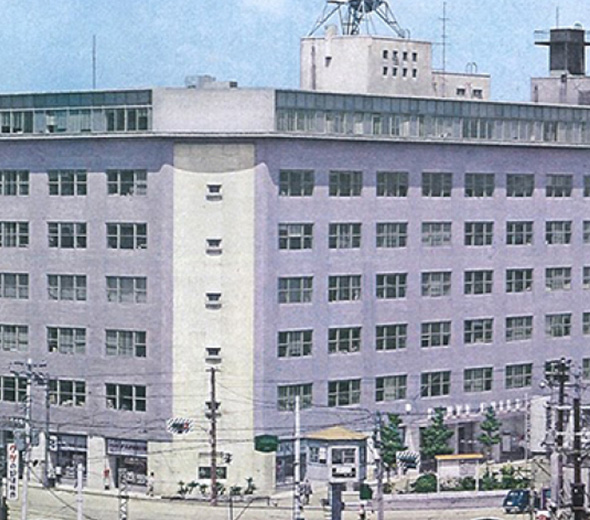
1950s - 1960s Economic Recovery and Establishing a Stable Supply
Economic recovery and increased demand for electricity
This period was a period of the first steps leading to rapid economic growth, driven by postwar recovery and the economic boom due to the Korean War. The main industries included steel, petrochemicals, and shipbuilding, while production of household appliances and passenger cars was also started. Industrial modernization, and the Jinmu and Iwato economic booms resulted in continued industrial expansion together with an increase in the demand for electricity.
There was a rapid spread of the use of fluorescent lighting in homes as well as household appliances such as electric rice cookers, electric heaters, black and white televisions, refrigerators, and washing machines. Improvements in living standards resulted in color televisions, air conditioners, and similar devices becoming widespread, as well as a significant increase in the demand for electric lighting.
Development of power resources to stabilize the demand and supply of electricity
The rapid increase in the demand for electricity resulted in a nationwide tightness in the supply and demand of electricity.Kyushu Electric Power also developed power resources with the construction of the Kamishiiba Power Station (hydropower), featuring Japan's first large-scale arch dam, and high-capacity state-of-the-art thermal power stations such as Unit 1 of the Omura Power Station. The main transmission system of Kyushu was constructed by connecting thermal power stations and major power consumption areas in northern Kyushu with hydropower stations in the south by using 220,000-volt transmission lines. As a result, the foundation for electricity supply was established ahead of the rest of the country.
Additionally, Kyushu Electric Power established a nuclear research laboratory based on the Atomic Energy Basic Act that was passed in 1955, which set forth the "peaceful use of atomic energy" as its basic policy. This was followed by the establishment of a policy to introduce nuclear power stations as well as a framework for their construction.
Major Milestones
| 1951 | Kyushu Electric Power is founded |
|---|---|
| 1955 | Kamishiiba Power Station (Miyazaki Pref.), featuring Japan's first large-scale arch dam, begins operation |
| 1956 | Unit 1 of the Karita Power Station (Fukuoka Pref.) begins operation |
| 1957 |
The voltage upgrade (220,000 volts) on the central trunk line, the Company's first extra-high voltage power transmission line, is completed Unit 1 of the Omura Power Station (Nagasaki Pref.) begins operation |
| 1967 | Otake Power Station (Oita Pref.), Japan's first commercial geothermal power station, begins operation |
TOPICS Japan's First Large-Scale Arch Dam
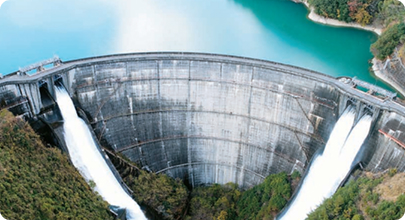
Kyushu is blessed with abundant resources such as water and geothermal energy, and attention was being focused on how to harness them. Thus, in 1953, we began construction on the Kamishiiba Dam located in the upstream area of the Mimi River, which flows through Miyazaki Prefecture. With no precedent in Japan and without the kind of modern construction equipment available today, we tackled the work while learning surveying, design, and construction from scratch. In 1955, Japan's first large-scale arch dam, standing 110 meters tall, was completed.
1970s - 1980s Meeting the Challenges of a Turbulent Energy Era
Oil crises, deregulation, and privatization
The first global oil crisis occurred in 1973 as a result of the Fourth Middle East War. As Japan relied on imported crude oil for some 80% of its energy, this plunged the country into chaos and resulted in negative economic growth for the first time since the war.The experience of the two oil crises marked a major turning point for Japan, spurring the development of energy conservation technologies, as well as the development and introduction of alternative energy sources.
Although the growth rate in the demand for electricity slowed due to the growing awareness of the need to conserve energy, the demand continued to grow steadily due to factors such as spreading urbanization, an increase in the number and height of commercial buildings (such as department stores and supermarkets), and the increasing size and diversification of home appliances driven by lifestyle changes.
Additionally, the 1970s and 1980s saw a trend towards deregulation in the US and UK, together with calls to open the Japanese market due to the widening US trade deficit with Japan, resulting in deregulation and privatization in Japan, particularly in the information and communications and financial services sectors.
Diversification of energy sources and laying the groundwork for the future
Following the oil crises, the Company focused on promoting diversification of energy sources to reduce dependence on petroleum. Unit 1 of the Genkai Nuclear Power Station, Kyushu Electric Power's first nuclear power station, started operation in 1975. This was followed by Genkai Unit 2, and Sendai Units 1 and 2 starting operation in the 1980s.In thermal power generation, the Company decided to introduce liquefied natural gas (LNG) in 1973, with Shin Kokura Units 1 and 2 starting LNG-only operation in 1977. In hydroelectric power generation, Ohira Units 1 and 2, a large-scale pure pumped-storage power station, started operation in 1975. Later, Hatchoubaru Unit 1, the Company's second geothermal power station, started operation in 1977.
In 1986, the China Wind Power Station, the Group's first, began operations, marking the Group's efforts to develop new energy as well. The 1980s saw the completion of the 500,000-volt main transmission system (transmission lines) that crossed Kyushu in a T shape. The Company developed and introduced an automated control system for distribution lines and live-line work methods ahead of the rest of the country, and also worked to improve supply reliability.
Meanwhile, to address the challenging business environment after the oil crises, the Company established a Headquarters for Management Efficiency Initiatives in 1982. With the aim of making effective use of its business resources and contributing to the advancement of information technology in the region, Kyushu Electric Power established information and telecommunications companies such as Kyushu Telecommunication Network (now known as QTnet) in 1987.
Major Milestones
| 1975 |
Unit 1 of the Genkai Nuclear Power Station (Saga Pref.), Kyushu Electric Power's first nuclear power station, begins operation Ohira Power Station (Kumamoto Pref.), Kyushu Electric Power's first large-scale pumped-storage power station, begins operation |
|---|---|
| 1977 |
Units 1 and 2 of Shin Okura Power Station (Fukuoka Pref.), Kyushu Electric Power's first LNG-only power station, begin operation Hatchoubaru Power Station (Oita Pref.), Kyushu Electric Power's second geothermal power station, begins operation |
| 1984 | Unit 1 of the Sendai Nuclear Power Station (Kagoshima Pref.) begins operation |
| 1985 | T-shaped 500,000-volt main transmission system is completed |
| 1986 | An automated distribution lines control system, the first in Japan, is introduced at the Fukuoka Office |
| 1987 | Three telecommunications companies, including Kyushu Telecommunication Network (now known as QTnet), are established |
| 1989 | Unit 1 of the Matsuura Power Station, Kyushu Electric Power's first imported coal-only thermal power station, begins operation |
TOPICS Expansion of the Information and Telecommunications Business
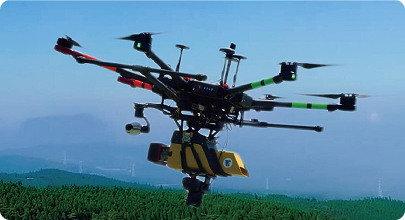
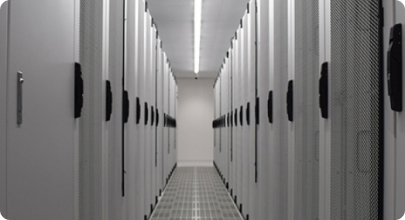
Aiming for the growth and stabilization of an economy slowed by the oil crisis, the Japanese government pushed through telecommunications reforms. In 1985, legislation concerning the liberalization of telecommunications was put into effect to revitalize the telecommunications industry. Taking this opportunity, our Group entered the information and telecommunications business. Today, we have established telecommunications infrastructure that covers the entire Kyushu region, and we continue to undertake challenges in a wide range of business areas including data centers, generative AI, and drones.
1990s - 2000s Electricity Deregulation and Undertaking New Business Ventures
Collapse of the bubble economy and long-term stagnation
The bubble economy that began in the second half of the 1980s culminated in the Nikkei Stock Average reaching a record high (at that time) in 1989. After that, however, stock and land prices started to decline, leading to problems of non-performing loans and deteriorating financial conditions of financial institutions. The Japanese economy entered a period of long-term stagnation.
Although the Japanese economy entered a period of recovery in the 2000s amid a backdrop of a global economic boom, the collapse of Lehman Brothers in 2008 triggered a global financial crisis and the deterioration of the real economy, leading to a global recession.The trend toward deregulation that started in the 1980s also came to the electric power industry. Competition was introduced into the power generation market in 1995 and liberalization of the electricity retail market expanded gradually from 2000 onward.
Additionally, as responding to global warming became an international issue, the Kyoto Protocol, which included greenhouse gas reduction targets, was adopted at the Third Conference of the Parties (COP3) to the United Nations Framework Convention on Climate Change, held in Kyoto in 1997. Accordingly, the national government, local governments, and businesses started implementing formal measures to reduce greenhouse gas emissions.
Towards achieving a low-carbon society
Electricity demand continued to grow steadily despite the economic downturn following the collapse of the bubble economy. Amid this, Kyushu Electric Power started operation of various power stations and sought to diversify power resources in order to provide a stable supply of electricity and reduce costs. Stations that started operation included Shin Oita System 1 (LNG) in 1991, Genkai Units 3 and 4 (nuclear) in 1994 and 1997, Reihoku Unit 1 (coal) and Yamagawa Power Station (geothermal) in 1995, and Omarugawa Unit 4 (pumped-storage) in 2007. As part of efforts to achieve a low-carbon society, the Company started proactively introducing renewable energy sources with Koshikijima Wind Power Station and Noma-Misaki Wind Park Station starting operation in 2003. Furthermore, with the aim of establishing the nuclear fuel cycle, Japan's first plutonium-thermal power generation began at Genkai Unit 3 in 2009.
The Company began considering entry into overseas businesses against the backdrop of factors such as the gradual progress of electricity deregulation and the slowing growth of domestic electricity demand. In 1999, it established Kyuden International to conduct operations specializing in overseas business. In 2009, it also established Kyuden Ecosol (now known as Kyuden Mirai Energy), the first company in Japan to engage in the on-site solar power generation business. Viewing changes in the business environment as opportunities, the Company proactively expanded its business.
In 2007, "Enlighten Our Future" was established as a new corporate philosophy in order to build long-term trust-based relationships with society and customers, even amidst changing times. In response to growing social interest in global warming and corporate social responsibility (CSR), the Company established the "Kyushu Electric Power Group Environmental Charter" and "Kyushu Electric Power Group Conduct Charter" among other initiatives, aiming for coexistence with society and sustainable business operations.
Major Milestones
| 1991 |
System 1 of Shin Oita Power Station (Oita Pref.), Kyushu Electric Power's first adoption of gas combined-cycle system, begins operation Typhoon No. 19 wreaks havoc all across Kyushu, resulting in Kyushu Electric Power's largest power outage (approx. 2.1 million households) since its founding |
|---|---|
| 1994 | Unit 3 of the Genkai Nuclear Power Station (Saga Pref.) begins operation |
| 1995 | Unit 1 of the Reihoku Power Station (Kumamoto Pref.) begins operation |
| 1999 | Kyuden International is founded |
| 2001 | Tuxpan (Mexico) II IPP project, Kyushu Electric Power's first overseas business project, is launched |
| 2003 | Koshikijima Wind Power Station and Noma-Misaki Wind Park Station (Kagoshima, Pref.) begin operation |
| 2005 | Goto Archipelago Link, Japan's longest submarine power cable (at that time), begins operation |
| 2007 | Our new corporate philosophy, "Enlighten Our Future," is established |
| 2009 |
Japan's first plutonium-thermal power generation starts at Unit 3 of the Genkai Nuclear Power Station Kyuden Ecosol is established as Japan's first on-site solar power generation business |
TOPICS Meeting the Challenges of Going Overseas
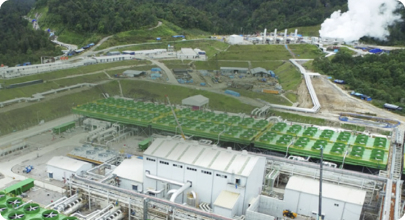

Since the 1990s, the Group has been engaged in businesses such as power generation and transmission around the world, with a focus on Asia, which has high growth potential. We dispatch engineers and commercial staff to the site and accumulate knowledge through deep involvement in the business. We leverage the knowledge that we cultivated in each project and are building a cycle of growth. Building on the spirit that pioneered our overseas business, we will continue to contribute to solving global issues.
2010s - 2020s Overcoming the Earthquake Disaster and Leading Japan's Decarbonization from Kyushu
Increasing severity of natural disasters and growing uncertainty regarding international affairs
On March 11, 2011, the tidal wave caused by the Great East Japan Earthquake reached the Tokyo Electric Power Company's Fukushima Daiichi Nuclear Power Station. Water entered the reactor and important safety functions such as status monitoring were lost, resulting in an extremely severe accident in which the core was damaged. In light of this accident, the Nuclear Regulation Authority was established in 2012 and made responsible for safety regulations of nuclear power stations. New regulatory standards were established in 2013.
The nuclear power station accident together with the subsequent severe strain on electricity supply and demand led to progress in electric power system reforms. These included the establishment of the Organization for Cross-regional Coordination of Transmission Operators in 2015, full liberalization of the electricity retail market in 2016, and legal unbundling of the transmission and distribution sector in 2020. The Feed-in Tariff (FIT) scheme for renewable energy was started in 2012 to promote the expansion of renewable energy sources.
Meanwhile, extensive damage was caused by natural disasters such as the Kumamoto Earthquake in 2016, as well as various other earthquakes, typhoons, and torrential rain in areas all across Japan. Additionally, Russia invaded Ukraine in 2022. It became increasingly difficult to secure energy resources such as natural gas and oil, sending prices soaring.
A promise to improve the safety of nuclear power
and efforts to create a new system
The accident at the Fukushima Daiichi Nuclear Power Station caused a massive loss of public trust in the safety of nuclear energy, resulting in the suspension of operations at all of Kyushu Electric Power's nuclear power stations by the end of 2011. The Company implemented various safety measures, passed reviews to ensure compliance with the new regulatory standards, and gained the support of the local community, resulting in restarting normal operation at Sendai Unit 1 in 2015, the first unit in Japan to do so.The Kumamoto Earthquake caused massive power outages due to landslides in areas around power transmission towers and similar problems. With support from power companies all across Japan in addition to partner companies, the Company devoted all its efforts to the restoration work.The second half of the 2010s saw the rapid spread of renewable energy sources such as solar due to the introduction of the FIT system. Based on Japan's priority dispatch rules, efforts are being made to achieve both the expansion of renewable energy sources and the stable supply of electricity.
Additionally, reforms to the electric power system led to the splitting off of the transmission and distribution sector to form the Kyushu Electric Power Transmission and Distribution subsidiary in 2020. That same year, the Urban Development Business Headquarters was established to respond to social and market trends by strengthening collaboration among the urban development, real estate, and infrastructure service businesses.In 2025, the "Kyuden Group Strategic Vision 2035" was formulated as the Company's medium- to long-term business direction. KYUDEN Holdings will be founded in 2026 to drive further growth of the Kyuden Group, and the Group will transition to a holding company structure.
Major Milestones
| 2010 | Mega Solar Omuta Power Station (Fukuoka Pref.), Kyushu Electric Power's first large-scale solar power station, begins operation |
|---|---|
| 2011 | Operation of all Kyushu Electric Power nuclear power stations is stopped |
| 2014 | Name of Kyuden Ecosol is changed to Kyuden Mirai Energy |
| 2015 |
Operation of Genkai Unit 1 is stopped (operation of Unit 2 is also stopped in 2019) Sendai Unit 1 resumes normal operation |
| 2016 |
A maximum of 476,000 households suffer power outages due to the Kumamoto Earthquake. Electric power companies dispatch support personnel and power supply vehicles Buzen Storage Battery Substation (Fukuoka Pref.), equipped with one of the world's largest storage battery capacity systems (at that time), begins operation |
| 2017 | Geothermal IPP project in Sarulla (Indonesia) begins operation |
| 2019 |
Unit 2 of the Matsuura Power Station (Nagasaki, Pref.) begins operation "Kyuden Group Strategic Vision 2030" is established |
| 2020 |
Kyushu Electric Power's transmission and distribution sector is split off to form the Kyushu Electric Power Transmission and Distribution subsidiary The Urban Development Business Headquarters is established to take full responsibility for all urban development, real estate, and social infrastructure (such as port operations) businesses |
| 2021 | "Kyuden Group Carbon Neutral Vision 2050" is established |
| 2024 |
Kyushu Electric Power's geothermal business is integrated into Kyuden Mirai Energy (Responsible for the five main renewable power sources of solar, wind, biomass, geothermal, and hydropower) |
| 2025 | "Kyuden Group Strategic Vision 2035" is established |
| 2026 |
Hibiki Power Station (Fukuoka Pref.), a high-efficiency LNG combined cycle system, starts operation Kitakyushu Hibikinada Offshore Wind Farm, largest offshore wind power facility in Japan (when completed), starts operation |
TOPICS "Community Development" by a Power Company
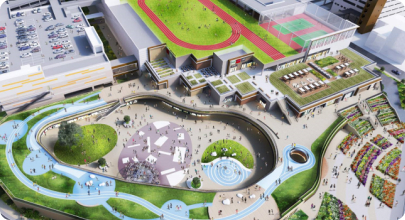
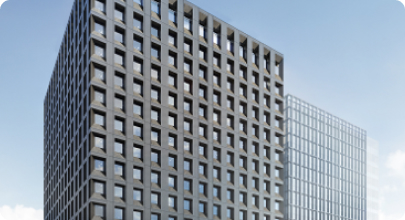
Through many years in the electric power business, our Group has cultivated know-how in civil engineering and construction, real estate management, ICT, and more. Urban development will create new electricity demand, and we anticipate Group-wide revenue growth. In 2020, we established the Urban Development Business Division and made a full-scale entry into the urban development business. We will leverage the unique strengths that only a power company can offer to help develop attractive communities.