Pursuing sustainable growth even
in a changing era
Since our founding in 1951,we at the Kyuden Group have facednumerous turning points
as we progressed over the years, and we haveflexibly adapted
while cultivating our strengths.
Strengths1High ratio ofzero-emission power sources
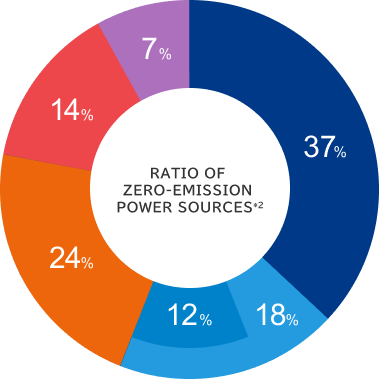
As demand for environmental value continues to grow, the Kyuden Group has a ratio of zero-emission power sources that is among the highest in the industry, achieved through the high capacity factor of our nuclear plants and the expansion of renewable energy sources that make use of Kyushu's abundant natural resources. Building on this foundation, we will steadily turn the growing demand for decarbonization into earnings.
Related capital
Nuclear power plant utilization rate
Renewable electricity sales *1
*1 Includes sales overseas and sales of FIT electricity without non-fossil certificates (which has no value as renewable energy or as a CO2zero-emission power source).
Ratio of zero-emission power sources *2
55%
*2 The figures are the ratio to the amount of electricity generated and received by Kyushu EP before Non-Fossil Fuel Certificate trading. The portion of the above that does not use non-fossil fuel certificates has no value as renewable energy, or as a CO2-free power source, and is treated as having the same CO2 emissions as the national average for electricity, including thermal power generation.
Strengths2Talent base
Since our founding, respect for people as the source of corporate value creation has run through our organizational culture, and it is now part of the Kyuden Group's DNA. Looking ahead to operating under a holding company structure, we are focused on securing and developing not only people with the skills and know-how in safety and stable power supply that we must hold on to, but also specialists in growth areas. And across the Group, a spirit of taking on new challenges is steadily taking root.
Related capital
Employees(consolidated)
21,189people
Number of major certifications held *3
14,738cases
(cumulative total)
Percentage of mid-career hires
among total hires
19.7%
Number of digital transformation
(DX) specialist training participants
470people
(cumulative total)
KYUDEN i-PROJECTParticipants*4
1,480people
(cumulative total)
Number of new business
and service
developments*5
13
*3 Covers official certifications required or important for operations in each business and division (Chief Electrical Engineer (Type 1), Chief Nuclear Reactor Engineer, etc.)*4 A project to drive innovation across the Kyuden Group, fostering the creation of new businesses and services*5 Includes projects undertaken by individual businesses and divisions in addition to those under KYUDEN i-PROJECT.
Strengths3Regional base in Kyushu
With semiconductor plants, data centers, and other industries clustering here, Kyushu has some of the highest growth potential of any region in Japan. Momentum for regional economic development is also building, and the trust we have earned with the people of Kyushu over the years is a major strength as we expand our business. Drawing on a network grounded in that trust, we will work with local communities to co-create social and economic value and shape the future of Kyushu together.
Related capital
Trust in the Kyuden Group
74.6%
Number of comprehensive
partnership agreements (Kyushu EP)
62municipalities +2 from the previous fiscal year
Cases of serious compliance violations
0
Number of partners (procurement)
2,667companies*6 +8 from the same period of the previous year
Cases of serious human rights
violations (including the entire supply chain)
0
*6 As of July 2026
Strengths4Stronger earning power
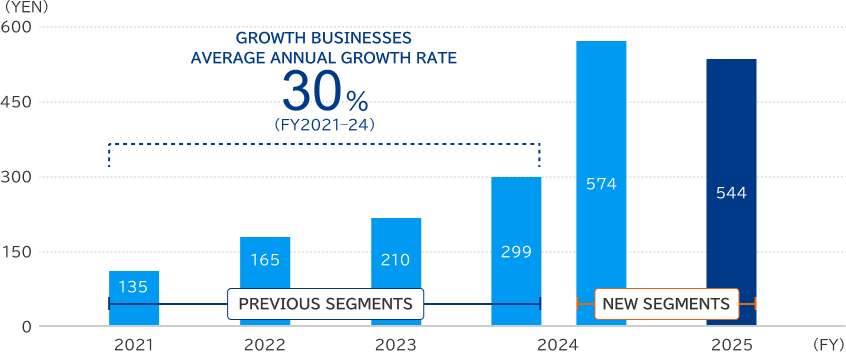
Our energy services businesses have continued to steadily increase profits even as geopolitical and other risks have materialized, demonstrating their growing earnings power. Our growth businesses (renewable energy, overseas, ICT services, and urban development) also recorded average annual ordinary income growth of 30% from FY2021 to FY2024.ROE has averaged above 10% in recent years (excluding preferred shares), and we aim to keep it consistently above our cost of equity even as we expand our equity capital.
Related capital
Ordinary income (energy services businesses)
*7 Excluding the effects of time lag
ROE
Ordinary income (growth businesses)
*8 Business segments were revised in Kyuden Group Strategic Vision 2035, announced in May 2025 (including the transfer of part of the domestic electricity business to the renewable energy business)
Challenges1Strengthening our financial base
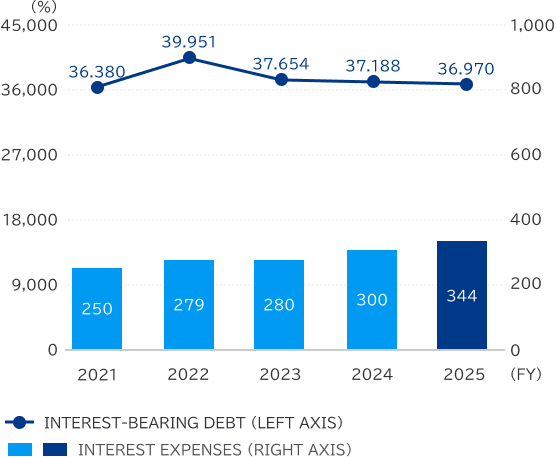
Our equity ratio is recovering as earning power grows, but given the rising uncertainty in the business environment, we need to raise it to a level that would consistently stay at or above 20% even after redeeming preferred shares and other equity-type capital.Now that interest rates have returned, we also need to hold down interest-bearing debt, which has roughly doubled since FY2009, as far as possible.To achieve both at once, each of our businesses will further advance ROIC-based management with a focus on capital efficiency.
Related capital
Equity ratio
Interest-bearing debt / interest expenses
Challenges2Raising market expectations
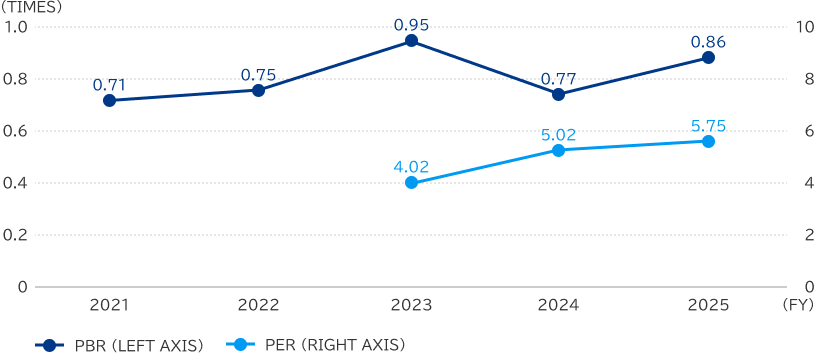
Our price-to-book ratio (PBR) remains below 1.0. We see our low price-to-earnings ratio (PER) as an issue, and we need to raise the market's expectations of the Group. We will continue our careful dialogue with the market to make the case for the Group's growth potential. At the same time, we are now considering revisions to our profit targets and shareholder return policy so that we can meet the market's expectations while continuing to strengthen our financial base.
Related capital
PBR/PER
*9 Calculated from the share price, EPS, and BPS at each fiscal year-end. FY2021 PER was 80.97 times (share price ¥817, EPS ¥10.09). FY2022 PER cannot be calculated because EPS was negative.